THERMAL CALIBRATION SERVICE About
We are a leading service provider for calibration of various types of parameters in all industries and our lab is accredited by (NABL)National Accreditation Board for Testing and Calibration laboratories from Chennai, Tamil Nadu, India.Temperature(Contact) Range from -80 deg C to 1500 deg cType of Instruments Calibrated:
- Digital Thermometer
- Glass Thermometer
- Dry block Calibrators
- Thermocouple and RTD probes
- Thermistors
- Temperature Recorder
- Temperature Scanner/Data logger
- Temperature Indicator with sensor
- Temperature Gauge
- Temperature Transmitter
- Temperature bath,etc.,
Mapping and Validation for single or multi point
- Freezer
- incubator
- oven
- furnance
- Storage rooms
- clean rooms
- dryer
- cold rooms
- Environmental chambers
- Humidity Indicator/chamber, etc.,
Temperature(Non-Contact)Range from 0 deg c to 1500 deg cType of Instruments Calibrated
- Non-Contact Pyrometers
- IR thermometer
- Black Body Source, ect.,
Humidity: Range from 5 to 60 deg c & 10 to 95%Type of Instruments Calibrated
- Humidity sensors/Transmitter
- Humidity/Temperature logger
- Analog hygrometer
- digital thermal hygrometer
- Thermo hygro graph
- Humidity chamber etc.,
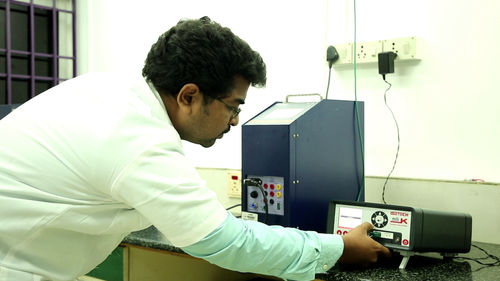
Note: Price May vary based on quantity and instrumentsComprehensive Temperature Calibration CoverageCalibrate your laboratory and industrial temperature instruments with confidence. Our service covers a temperature range from -80C to 1200C and supports a diverse set of equipment, such as thermometers, RTDs, thermocouples, ovens, and baths. Whether you require calibration onsite or in our laboratory, we tailor our process to fit the specific instrument size and your operational needs.
Unmatched Traceability and AccuracyWe employ comparison calibration methods using master standards traceable to NABL/ISO 17025-accredited national and international standards. Customers benefit from high accuracy, up to 0.05C, which is vital for process control, research, and manufacturing environments requiring dependable temperature measurement.
Reliable and Efficient Service DeliveryOur thermal calibration services are designed for minimal disruption and quick turnaround. Detailed calibration certificates with before and after data are issued within 3-5 working days. As a trusted exporter, manufacturer, service provider, and supplier in India, we offer flexible onsite and offsite solutions to meet customer requirements efficiently.
FAQ's of THERMAL CALIBRATION SERVICE:
Q: How is the thermal calibration performed for different temperature instruments?
A: Thermal calibration is carried out by comparing your instrument against a master standard or reference equipment under controlled conditions. The process ensures traceability to NABL/ISO 17025-accredited national or international standards.
Q: What types of instruments and temperature ranges can be calibrated with this service?
A: We calibrate a wide array of instruments, including thermometers, RTDs, thermocouples, ovens, baths, data loggers, temperature controllers, and laboratory/process equipment, ranging from -80C to 1200C.
Q: When should I consider recalibrating my temperature measurement devices?
A: Recalibration should be performed at regular intervals specified by industry regulations, after major repairs, or anytime you suspect measurement discrepancies. Regular calibration ensures ongoing measurement accuracy and compliance with quality standards.
Q: Where can thermal calibration services be conducted?
A: We offer both onsite calibration at your facility and offsite laboratory calibration in our accredited lab, depending on your operational requirements and instrument portability.
Q: What is the typical process and documentation provided?
A: After receiving your instruments, we calibrate them using master standards, record before and after readings, and then issue a detailed calibration certificate showing all relevant data, traceable to standard regulations.
Q: How can accurate thermal calibration benefit my laboratory or industrial operations?
A: Accurate calibration ensures reliable temperature measurements, supporting process control, quality assurance, safety, and regulatory compliance, ultimately improving operational efficiency and reducing the risk of costly errors.